Assumption of Risk
Revised Makeup Class Plan
Wednesday, April 9 - Class starts at 9:10am
Wednesday, April 16 - Class starts at 9:10am
Makeup class on Thursday, April 24 (Flex Day) - 10:10am - 11:50am
NO makeup class on Thursday, April 17
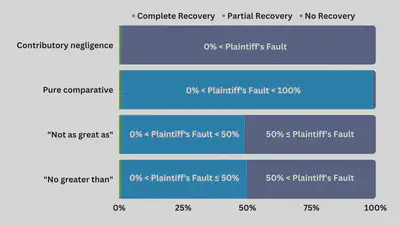
Comparative Negligence
Three forms:
- Pure comparative negligence
- “Not as great as” = (Plaintiff less than 50% at fault)
- “No greater than” = (Plaintiff 50% or less at fault)
Can the negligent plaintiff recover damages?
If multiple defendants are liable, how much are they each paying?
Doctrine of Contribution
Traditional Common Law Approach
Two versions:
- Joint and several liability
- Several liability
Apportionment based on factual cause
Don’t
forget about
factual cause!
Don’t forget about factual cause!
Tortfeasors are only liable for the injuries they caused.
Order of operations with multiple injuries and multiple liable defendants
First step:
Separate injuries based on factual cause.
Second step:
For injuries that multiple defendants caused, sort out liability based on the contribution rule in the jurisdiction.
Doctrine of Contribution
Traditional Common Law Approach
Example:
Four defendants (A, B, C, and D) with $100k damages.
Joint and several liability jurisdiction
A, B, C, and D have plenty of money
Who pays what?
Doctrine of Contribution
Traditional Common Law Approach
Example:
Four defendants (A, B, C, and D) with $100k damages.
Several liability jurisdiction
A, B, C, and D have plenty of money
Who pays what?
Doctrine of Contribution
Traditional Common Law Approach
Example:
Four defendants (A, B, C, and D) with $100k damages.
Joint and several liability jurisdiction
A and B have plenty of money
C and D have no money
Who pays what?
Doctrine of Contribution
Traditional Common Law Approach
Example:
Four defendants (A, B, C, and D) with $100k damages.
Several liability jurisdiction
A and B have plenty of money
C and D have no money
Who pays what?
Doctrine of Contribution
Modern Approach
Apportionment based on comparative fault.
Example: Four defendants (A, B, C, and D) with $100k damages.
A is 40% at fault.
B is 10% at fault.
C is 20% at fault.
D is 30% at fault.
Doctrine of Contribution
Modern Approach
Apportionment based on comparative fault.
Example: Four defendants (A, B, C, and D) with $100k damages.
A is 40% at fault. So A owes $40k.
B is 10% at fault. So B owes $10k.
C is 20% at fault. So C owes $20k.
D is 30% at fault. So D owes $30k.
What about vicarious liability?
—
Vicarious liability and the doctrine of contribution
Modern Approach
Apportionment based on comparative fault.
Example: Four defendants (A, B, C, and D) with $100k damages.
A is 40% at fault.
B is 10% at fault.
C is 20% at fault.
D is 30% at fault.
E is vicariously liable for D’s negligence.
Vicarious liability and the doctrine of contribution
Modern Approach
Apportionment based on comparative fault.
Example: Four defendants (A, B, C, and D) with $100k damages.
A is 40% at fault. So A owes $40k.
B is 10% at fault. So B owes $10k.
C is 20% at fault. So C owes $20k.
D is 30% at fault. E is vicariously liable for D’s negligence. So E owes $30k.
Fritts v. McKanne
McCarty v. Pheasant Run, Inc.
“Unlocked Hotel Room Door”
and
Wassell v. Adams
“Opened Hotel Room Door”
Discussion Questions
Given the facts of these cases, what would a just outcome in each case have been?
How capable is our legal system of producing just outcomes in these cases? How does it fall short? What would need to change?
Assumption of Risk
[fit] Hanks v. Powder Ridge Restaurant Corp.
“Snowtubing Waiver”
Two Common Issues
- Was the contract clear enough about releasing the defendant from liability?
- Will the court enforce contract?
- I fully assume all risks associated with [s]nowtubing, even if due to the NEGLIGENCE of [the defendants]
- I … agree I will defend, indemnify and hold harmless [the defendants] … from any and all claims, suits or demands … including claims of NEGLIGENCE on the part of [the defendants]
- I will not sue [the defendants] … for money damages for personal injury … even if due to the NEGLIGENCE of [the defendants]
Will the court enforce contract?
Various legal tests for determining if liability waiver is against public policy:
- Liability waivers are unenforceable
- Totality of the circumstances
- Six factors from Tunkl
Tunkl factors
- Business of a type generally thought suitable for public regulation.
- Defendant performs a service of great importance to the public (often a matter of practical necessity for some members of the public)
- Defendant willing to perform this service for any member of the public
- Defendant has bargaining advantage
- Standardized adhesion contract of exculpation
- Plaintiff placed under the control of the defendant, subject to the risk of carelessness by the seller or his agents.
Tort Law Values
| Era | Philosophy | Primary Goal | Concern |
|---|---|---|---|
| Classical | Corrective justice | Individual accountability | Autonomy |
| Neoliberal | Economics | Maximize utility | Efficiency |
Tort Law Values
| Era | Philosophy | Primary Goal | Concern |
|---|---|---|---|
| Classical | Corrective justice | Individual accountability | Autonomy |
| New Deal | Political Economy | Distributive justice | Power |
| Neoliberal | Economics | Maximize utility | Efficiency |
Murphy v. Steeplechase
“The Flopper”
volenti non fit injuria
volenti non fit injuria
“to one who is willing, no wrong is done”
Cardozo’s counter-examples
- “Obscure and unobserved” dangers
- Too many accidents
—
Knight v. Jewett
“Touch Football Injuries”
—