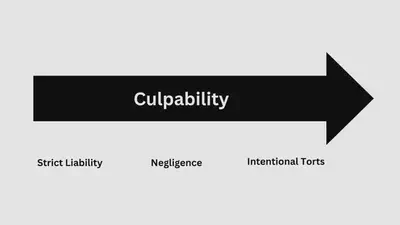
Intentional Torts
No class on Friday
Office Hours
Today from 12pm to 1pm
Classes next week
Monday - 8:00am - 9:40am - Insurance
Tuesday - 10:10am - 11:50am - Workers’ Compensation
Wednesday - 8:00am - 9:40am - No Fault and Beyond
Thursday - 10:10am - 11:50am - No Fault and Beyond / Review
Office hours next week
Wednesday - 12:00pm - 1:00pm
Thursday - 12:00pm - ???
Structure
Intentional Torts:
— Battery
— Assault
— False imprisonment
— Intentional infliction of emotional distress
Defenses:
— Consent
— Self-defense
— Defense of property
— Necessity
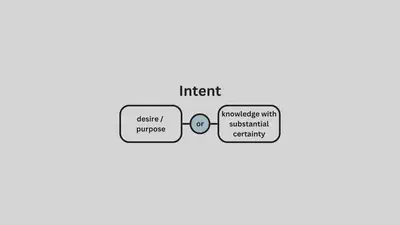
Abridged Definition from Restatement (Third) of Torts
A person acts with the intent to produce a consequence if:
(a) the person acts with the purpose of producing that consequence; or
(b) the person acts knowing that the consequence is substantially certain to result.
—
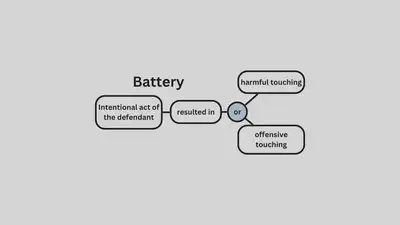
Battery
Abridged Definition from Restatement (Second) of Torts
An actor is subject to liability to another for battery if he acts intending to cause a harmful or offensive contact with the person of the other or a third person, or an imminent apprehension of such a contact, and a harmful or offensive contact with the person of the other directly or indirectly results.
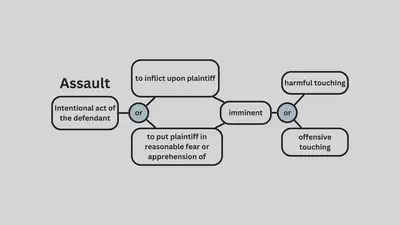
Assault
Abridged Definition from Restatement (Second) of Torts
An actor is subject to liability to another for assault if
(a) he acts intending to cause a harmful or offensive contact with the person of the other or a third person, or an imminent apprehension of such a contact, and
(b) the other is thereby put in such imminent apprehension.
With intentional torts, always consider
- The legal interest that each intentional tort addresses
- The requirements of the defendant
- The requirements of the plaintiff
- Any objective requirements, including analysis that the judge or jury must conduct
The legal interest that each intentional tort addresses
Battery
Freedom from harmful or offensive contact
Assault
Freedom from apprehension of harmful or offensive contact
False Imprisonment
Freedom from confinement
IIED
Freedom from severe emotional distress
False Imprisonment
Lopez v. Winchell’s Donut House
“The Accused Employee Who Freely Left”
False Imprisonment
Interest Protected: Freedom from confinement
Abridged Definition from Restatement (Second) of Torts
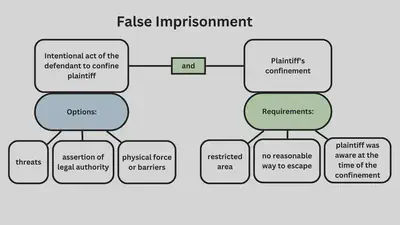
An actor is subject to liability to another for false imprisonment if
(a) he acts intending to confine the other or a third person within boundaries fixed by the actor, and
(b) his act directly or indirectly results in such a confinement of the other, and
(c) the other is conscious of the confinement or is harmed by it.
Intentional Infliction of Emotional Distress
Womach v. Eldridge
“The Distressing Accusation of Molestation”
Intentional Infliction of Emotional Distress
Interest Protected: Freedom from severe emotional distress
Second Restatement Definition
“One who by extreme and outrageous conduct intentionally or recklessly causes severe emotional distress to another is subject to liability for such emotional distress, and if bodily harm to the other results from it, for such bodily harm.”


Snyder v. Phelps
“Protesting Soldiers’ Funerals”
Defenses
Consent
Self Defense
Defense of Property
Necessity
Consent
Hart v. Geysel
“Consenting to a Prize Fight”
Hackbart v. Cincinnati Bengals
“Professional Football Injury”
O’Brien v. Cunard
“The Silent Vaccine Objector”
—
Self Help Defenses
Self Defense
Defense of Property
Necessity
—
Self defense
Courvoisier v. Raymond
“Mistaken Self-Defense”
—
Defense of property
Katko v. Briney
“The Spring-Gun Boobytrap”
—
Necessity
Ploof v. Putnam
“The Private Island in a Storm”
Vincent v. Lake Erie Transportation Company
“The Boat Slamming Against the Dock”
—
Hand Formula
B < P*L
Negligence when the burden on the defendant of taking precautions is less than the probability of loss for the plaintiff multiplied by the magnitude of that loss.