Midterm Review
You should be worried.
The Exam Itself
Examples of what you might be asked to do:
Make a legal argument that a defendant did or did not owe the plaintiff a duty of care.
Make a legal argument that a defendant did or did not exercise reasonable care / breach duty to plaintiff.
Make a legal argument that a damages award (compensatory or punitive) was or was not excessive.
Make a policy argument about the merits of adopting a potential legal rule.
General Questions
Do you prefer to have our answer broken up into each element separated amongst each other (I_R_A_C). Or do you prefer one long paragraph for each IRAC?
Could we please review how to craft an argument for duty versus an argument for reasonable care?
When asked to make the strongest argument, do we also need to explain why the alternative arguments fail?
How will Jurisdiction work for Supreme Court Cases and do we need to memorize which are Supreme Court Cases?
If I made a Res Ipsa argument, can I also talk about reasonable care as a safety net in case the Res Ipsa argument is not strong?
If the call to action asks if Res Ipsa can be applied, or if Negligence Per Se is appropriate, and the answer is no, should a reasonable care argument always be made if it feels stronger?
Damages
Two separate legal inquiries:
- Liability
- Damages
Compensatory
Damages
and punitive damages
Compensatory Damages
The Objective: To restore the plaintiff to the state they were in before the harm caused by the defendant.
Questions
In McDougald v. Garber, without cognitive awareness, is it only non-economic damages that are unavailable, or does that also extend to economic damages?
I start to get a little confused regarding when the limit is met for compensatory damages and how any further nonpecuniary damages assessed become punitive? How do we know we’ve reached that limit?
Punitive Damages
BMW v. Gore Guideposts
- Degree of reprehensibility
- Ratio of punitive damages to harm inflicted on plaintiff
- Comparison with civil or criminal penalties
State Farm Excess of single digit ratio is presumptively unconstitutional
—
Questions
When looking at the ratio of actual harm to the punitive damages awarded, how does willful and wanton conduct play a role in that? Is that an exception to the State Farm standard? Additionally, what constitutes willful and wanton conduct when addressing reprehensibility?
In a case where punitive damages may be warranted, can the court take into consideration that while they may be deserved, they aren’t necessary because in the case of high compensatory damages, that serves the role punitive damages otherwise would have? Further, would it be valid to take into consideration that for a non-wealthy defendant, large compensatory damages are already punishment enough and therefore punitive damages should have only been $1?
Does the jurisdiction rule for punitive damages prevent courts from considering harm done in other states, even if the conduct was illegal there as well?
When should we start to consider Judge Posner’s concerns in Matthias? Do we analyze those in tandem with the three guideposts?
Negligence
Negligence as a Cause of Action
Plaintiff must prove four elements:
- Duty
- Breach
- Causation
- Harm
Negligence as a Concept
Relates to the elements of duty and breach
The “fault” principle
Defined as a failure to exercise “reasonable care”
Proving negligence

Questions
Could you please go over the steps for how to establish a prima facie case of negligence?
Why would someone go through the trouble of showing “negligence as a concept” and not a prima facie case by also showing causation and harm?
—
How does a plaintiff normally prove duty and breach?
D was legally obligated to do X.
D failed to do X.
Therefore, D breached their legal duty.
—
Detailed version
D had a duty (to the plaintiff) to exercise reasonable care under the circumstances. Reasonable care under the circumstances was X, because of - foreseeability, - reasonable person standard, - custom, - statute, - or hand formula.
D failed to do X.
Therefore D acted negligently / breached their legal duty to plaintiff.
—
Reasonable Person Standard
Objective standard
Exceptions to objective standard: - Physical disability - Children - Expertise
Not exceptions to objective standard - Mental disability - Children engaged in adult activity - Old age & infirmity
—
Questions
For the objective reasonable person exceptions, when should we stop comparing a child to children of the same age? I know children under 5 cannot be negligent. However, if we have an 8 or 9 year old, we compare them to other, reasonable 8-9 year olds. At what age does this exception stop working?
Foreseeability
Foreseeability is a flexible concept.
Define any event in general enough terms and it is foreseeable.
Define any event in narrow enough terms and it is unforeseeable.
How to use customs and statutes
Sword for proving negligence Prove two things:
- Custom or statute = reasonable care - Defendant failed to comply with custom or statute -————————————————— Shield for disproving negligence Prove two things:
- Custom or statute = reasonable care - Defendant complied with custom or statute
Negligence per se
- Actor violates a statute that is designed to protect against this type of accident and harm
AND
- the accident victim is within the class of persons the statute is designed to protect.
Questions
Just to double check/clarify, when we are making a foreseeability argument, we are making that argument in addition to something else, such as reasonable person standard. We won’t be able to prove the defendant is negligent just by saying the harm was foreseeable?
In a statute like the one on the 2025 midterm about the railing, why does the D not fail to meet the entire statute if one component is met and the other is not? Is that statute considered as two separate statutes within one code?
Hand Formula (BPL)
B = Burden of precautionary measures P = Probability of loss/harm L = Magnitude of loss/harm
IF B < PL AND defendant did not take on B THEN defendant was negligent
IF B > PL AND defendant did not take on B THEN defendant was NOT negligent
Questions: Hand Formula
Questions: Role of Judge & Jury
Is it correct to say that a case is decided on a matter of law if there was a directed verdict or summary judgement? Or does it depend on the issue?
Can please touch on the judge and jury relationship? Specifically, what is decided by matter of law, versus what is decided by matter of fact? When the question mentions “matter of law,” do we only analyze reasonable care factors that a judge can decide as a matter of law?
Res ipsa requirements:
- Harm results from the kind of situation in which negligence can be inferred
- Defendant was responsible for the instrument of harm
—
Questions: Res Ipsa
What are the differences between “presumption” jurisdiction, and “inference” jurisdiction as it relates to Res Ipsa? (This was on the 2022 practice midterm)
Could we go over the difference between proving Res Ipsa and Negligence Per Se? I understand that in a Res Ipsa case the plaintiff bears the burden of proof, but I am a little confused about this distinction. I was also wondering if Res Ipsa could apply for a situation where there is a statutory violation and the plaintiff is in the protected class?
Is it correct to say that res ipsa uses circumstantial evidence and does not require direct evidence? And that courts are less likely to allow the jury to apply res ipsa if the plaintiff has direct evidence?
Questions: Res Ipsa
Can we use the underlying principles of res ipsa (probabilistic rationale, asymmetry of information, and fairness justification) when arguing why res ipsa should apply to a fact pattern?
Can we revisit why Ybarra and McDougald are the limits of res ipsa?
Why would Res Ipsa not be the better argument for a question where it could work, like on the 2022 midterm with the nail protruding out of the playground? If it is a shortcut and an argument works, wouldn’t that make the financial harm to the defendant be better? Due to less litigation
Existence of Duty
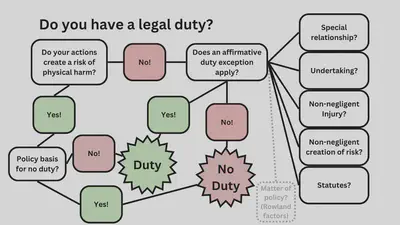
When answering a duty question, are we expected to name the duty required? Such as a duty to warn, a duty to help, etc. The Optometrist exercise would be a little ambiguous besides just saying that the defendant owed a duty to the plaintiff.
Could we go over the two lines of reasoning for the optometrist exercise?
In some examples of good answers on previous exams, students explain both the route by which the defendant’s action directly causes harm and the affirmative duties that the defendant has. Is it best to go both routes if the argument can be made, or is it better to go with what is strongest and acknowledge the other route in a counterargument?
Questions: Special Relationship
Could you go over what constituted a “special relationship” in affirmative duty exceptions? I know of the two scenariors (1) money exchanged, and (2) co-adventurers.
Undertaking
Questions: Non-negligent creation of risk & non-negligent creation of injury
Is the Union Pacific ruling still relevant today and usable in any way in our writing?
Is Maldonado about non-negligent creation of risk and non-negligent creation of injury? What about the employees shaking the train so the plaintiff would fall off?
Is it the case that in situations where we’ve identified that non-negligent creation of risk applies, non-negligent creation of injury will always also apply?
Why doesn’t the non-negligent injury exception apply to Tarasoff? I am unsure of when non-negligent injury would apply in general. Does the injury have to result from the defendant’s positive action?
Can non-negligent creation of risk apply to third parties?
Rowland Factors
- foreseeability of harm
- certainty of plaintiff’s injury
- connection between defendant’s conduct and plaintiff’s injury
- moral blame
- policy of preventing harm
- burden to defendant
- consequences to community
- availability of insurance
Which cases specifically apply or illustrate the Rowland factors?
On the flow chart used in class it says the Rowland factors can be used when making arguments about policy, like in the Tarasoff case. Can the Rowland Factors be used to find a legal duty of care even in cases where there aren’t wide-ranging policy issues like in Tarasoff?
Do the Rowland Factors only apply when assessing a duty to third parties as a matter of policy? Or could they also apply as a matter of policy to those with whom the defendant has a direct relationship?
If we are arguing that no affirmative duty applies, should we also need to explain why the Rowland factors would not create a duty?
Can you explain the way in which the Rowland factors and Policy base for the No Duty Act as a policy argument?
Policy Basis for No Duty
Question: No Duty
And then lastly, the legal duty flow chart is starting to click now, but I think the only part that’s not clicking just yet is the policy basis for no duty. Can we please go over the policy arguments you can make to determine no duty after you have answered yes to the initial question of “did the actions create a risk of physical harm?”
Duties of Landowners and Occupiers
—
Traditional View
| Type of Visitor | Definition |
|---|---|
| Trespasser | Intruder |
| Licensee | Social guest |
| Invitee | Business guest or general public (if land opened to public) |
Duties Owed — Traditional View
Trespasser duty not to intentionally or wantonly cause injury no duty of reasonable care (with handful of exceptions)
Licensee no duty to inspect or discover dangerous conditions duty to warn or make known conditions safe
Invitee duty to inspect and discover dangerous conditions duty to warn or make conditions safe
Modern View
| Type of Visitor | Definition |
|---|---|
| Trespasser | Intruder |
| Everybody else | Not a trespasser |
Duties Owed — Modern View
Trespasser1 duty not to intentionally or wantonly cause injury no duty of reasonable care (with handful of exceptions)
Everybody Else duty of reasonable care
—
Questions: Duty of Landowners and Occupiers
Is the duty to lawful visitors/licensees/invitees an affirmative duty that falls into the “special relationship” category? I’m basically wondering where in the flowchart this falls into our analysis.
Does the duty of landowners apply to employees? For example, do store employees have the same duty as the store owner/manager?
At the end of the Heins dissent, Fahrnbruch wrote, “Under the majority’s opinion, a homeowner would have potential liability for any number of not only uninvited but unwanted solicitors or visitors coming to the homeowner’s door.” I was confused about this sentence because it sounds like he is describing trespassers. Wouldn’t a homeowner not owe a duty of reasonable care to uninvited solicitors?
Or in California and the Third Restatement, a “flagrant” trespasser rather than just a plain old trespasser ↩︎