Review
Intentional Torts
Defenses
Consent Self Defense Defense of Property Necessity
Necessity
Ploof v. Putnam “The Private Island in a Storm”
Vincent v. Lake Erie Transportation Company “The Boat Slamming Against the Dock”
Hand Formula
B < P*L
Negligence when the burden on the defendant of taking precautions is less than the probability of loss for the plaintiff multiplied by the magnitude of that loss.
Review
You can use laptops for the rest of class today.
Medical Malpractice

Two types of negligence claims:
Negligent medical care
Lack of informed consent
Elements of a Claim
[.column]
Negligence
- Duty
- Breach
- Causation
- Harm
[.column] Strict Liability
- Defendant was engaged in the kind of activity where strict liability applies
- Causation
- Harm
[.column] Products Liability
- Defect
- Causation
- Harm
Limits on Strict Liability
Fletcher v. Rylands
— PWFOPBOHL&C&KTALDMIIE
Rylands v. Fletcher
— PWFOPBOHL&C&KTA “non-natural” and LDMIIE
First Restatement
— “ultrahazardous activity”
Second Restatement
— “abnormally dangerous activity”
Products Liability
— Manufacturing defects
— Design defects
— Instructions and warnings
Affirmative Defenses
Comparative Negligence
Assumption of Risk
Intentional Torts
Intentional Torts:
— Battery
— Assault
— False imprisonment
— Intentional infliction of emotional distress
Defenses:
— Consent
— Self-defense
— Defense of property
— Necessity
With intentional torts, always consider
- The legal interest that each intentional tort addresses
- The requirements of the defendant
- The requirements of the plaintiff
- Any objective requirements, including analysis that the judge or jury must conduct
The legal interest that each intentional tort addresses
Battery
Freedom from harmful or offensive contact
Assault
Freedom from apprehension of harmful or offensive contact
False Imprisonment
Freedom from confinement
IIED
Freedom from severe emotional distress
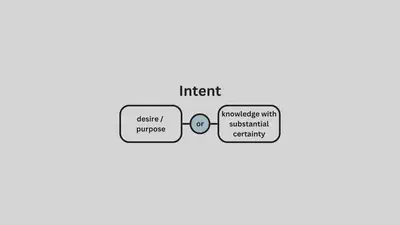
Abridged Definition from Restatement (Third) of Torts
A person acts with the intent to produce a consequence if:
(a) the person acts with the purpose of producing that consequence; or
(b) the person acts knowing that the consequence is substantially certain to result.
—
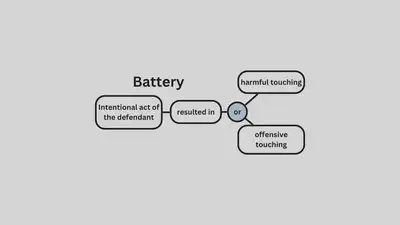
Battery
Abridged Definition from Restatement (Second) of Torts
An actor is subject to liability to another for battery if he acts intending to cause a harmful or offensive contact with the person of the other or a third person, or an imminent apprehension of such a contact, and a harmful or offensive contact with the person of the other directly or indirectly results.
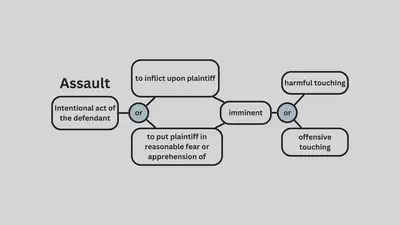
Assault
Abridged Definition from Restatement (Second) of Torts
An actor is subject to liability to another for assault if
(a) he acts intending to cause a harmful or offensive contact with the person of the other or a third person, or an imminent apprehension of such a contact, and
(b) the other is thereby put in such imminent apprehension.
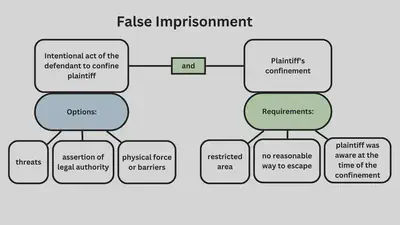
False Imprisonment
Interest Protected: Freedom from confinement
Abridged Definition from Restatement (Second) of Torts An actor is subject to liability to another for false imprisonment if (a) he acts intending to confine the other or a third person within boundaries fixed by the actor, and (b) his act directly or indirectly results in such a confinement of the other, and (c) the other is conscious of the confinement or is harmed by it.
[fit] Intentional Infliction of Emotional Distress
Interest Protected: Freedom from severe emotional distress
Second Restatement Definition “One who by extreme and outrageous conduct intentionally or recklessly causes severe emotional distress to another is subject to liability for such emotional distress, and if bodily harm to the other results from it, for such bodily harm.”

Different jurisdictions’ approaches to NIED
“Impact” Rule
“Zone of Danger”
“Bystander Liability”
Special, specified circumstances
Underlying tort law principles

Defenses: — Consent — Self-defense — Defense of property — Necessity
Intentional Torts Exercise
You are a personal injury attorney in the state of Loyola. In Loyola, a protest and counter-protest over gun regulations began to get out of hand. Annie stood at the front lines of the protest arguing for assault weapon regulation, and Bob stood at the front lines of the counter-protest arguing for free assault weapons for public school teachers. The two protests began on opposite sides of city park but grew closer together over the course of the day and were now squaring off face-to-face. Annie started addressing Bob directly. “You think it’s worth it for kids to die so you can pretend you’re a real man? What are you compensating for, buddy? Huh? Wife left you? Maybe instead of buying so many guns, you should buy a gym membership, you fat piece of shit!” As she screamed at him, flecks of spit kept landing on Bob’s face. She pointed her index finger right between his eyes, inches from his face as she said, “No one is ever going to love you.”
Bob drew his SIG Sauer P365 pistol from its holster on his hip and pointed it at the ground by his feet. “Back up. Stop spitting on my face. And stop being so mean to me.” “Are you going to shoot me?” Annie asked. “If I have to.” Bob responded. “I’m calling the cops,” Annie said, and retreated back into the crowd.
Annie did not call the cops. But she did sue Bob for assault. Bob has now hired you as his attorney. Having never been sued before, Bob wants you to advise him on his legal options. Please consider any defenses Bob might raise, any intentional tort claims he might have against Annie, and any defenses she might be able to raise. As you advise Bob, be sure to inform him of how strong or weak these claims or defenses are and why. For the purposes of this question, do not consider any negligence or strict liability claims.
Defenses for Bob
Defeating prima facie case
Self defense
Consent
Claims Bob could raise
Battery
Spit
Assault
Finger in the face
IIED
Mean things she said
Products Liability Exercise
You are a junior associate at a plaintiff-side firm. A partner at the firm has brought you in to work on an interesting new case. The potential plaintiff, a nine-year-old boy named Augustus Gloop, choked on a hot dog during lunch in his elementary school cafeteria. The child survived — thanks to a gym teacher’s training in first aid and CPR — but suffered serious injuries. His family is now interested in suing Oscar Meyer Weiner, the company that produced this hot dog.
The partner at your firm doesn’t typically litigate products liability cases, so she wants you to catch her up to speed. She’d like you to sketch out arguments supporting a failure to warn claim, a design defect claim, and a manufacturing defect claim. For each claim, provide an example of a piece of evidence that would help our client win. And let her know which claims have the best chance of success. On the failure to warn claim, you should know that Oscar Meyer Weiner does not have any warning labels on its packaging. The partner would also like you to evaluate any affirmative defenses that Oscar Meyer Weiner might raise.